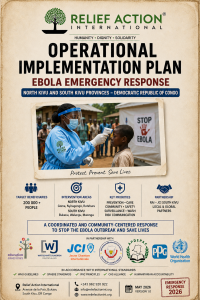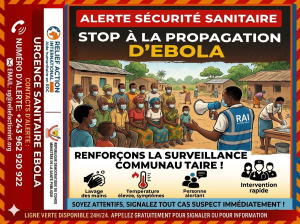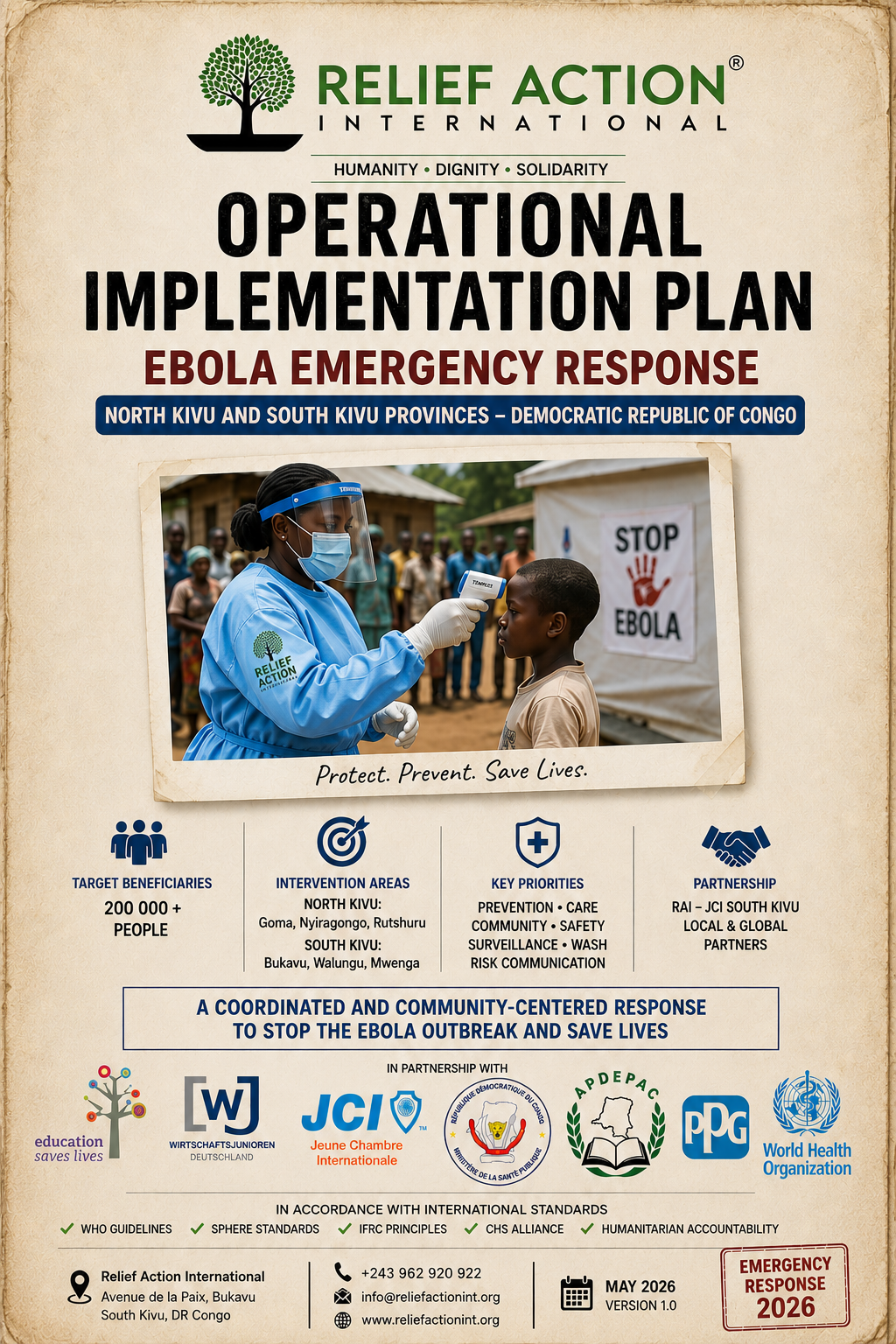
The eastern region of the Democratic Republic of Congo remains confronted with cyclical resurgences of the Ebola virus disease. These health crises directly threaten vulnerable citizens, disrupt school environments, and weaken the local healthcare system. In response to this critical situation, Relief Action International and Junior Chamber International South Kivu are mobilizing a coordinated humanitarian response.
This three-month emergency intervention is strategically deployed in the provinces of North Kivu and South Kivu. It primarily targets the zones of Goma, Nyiragongo, and Rutshuru, as well as Bukavu, Walungu, and Mwenga.
The fundamental objective of this program is to contain the spread of the virus and reduce transmission risks. To achieve this, the approach prioritizes rapid, multi-sectoral actions deeply anchored within community dynamics.
🎯 Performance Indicators and Priority Targets
To guarantee a measurable impact and ensure rigorous monitoring of interventions, the program commits to achieving the following quantitative targets:
- 40 school facilities secured: Equipped with functional handwashing infrastructure.
- 500 children assisted: Direct beneficiaries of individual cleanliness kits.
- 100 caregivers supported: Supplied with medical safety material and screening tools.
- 45,000 people sensitized: Reached through community outreach and national radio campaigns.
- 30 community agents mobilized: Trained to ensure epidemiological surveillance and local engagement.
⏳ Operational Strategy and Deployment Phases
The implementation of activities follows a strict protocol divided into four major phases:
- Phase 1: Rapid Emergency Mobilization
Activation of the humanitarian coordination cell, recruitment and deployment of technical personnel, and strategic alignment with health authorities. - Phase 2: Community Education and Security in Schools
Installation of handwashing stations in high-risk zones, distribution of hygiene supplies, and deployment of mass awareness campaigns. - Phase 3: Reinforcement of Frontline Health Facilities
Delivery of medical safety supplies and establishment of feedback mechanisms to adjust interventions based on community input. - Phase 4: Final Evaluation and Institutional Accountability
Consolidation of impact data, financial reconciliation, and submission of technical reports to funding partners.
🛡️ International Standards, Transparency, and Accountability
All interventions are conducted in strict compliance with international humanitarian standards. Teams rigorously apply the World Health Organization guidelines, the Sphere standards, and the core principles of the Humanitarian Accountability Partnership.
Institutional Commitments of the Organization:
- Absolute Financial Transparency: Strict budget tracking and complete traceability of all operational expenditures.
- Accountability to Affected Populations: Deployment of two-way communication channels, including complaint committees, suggestion boxes, and a dedicated telephone helpline.
- Inclusion and Equity: Systematic integration of the specific needs of children, women, the elderly, and people living with disabilities.
- Safety and Integrity: Strict application of a zero-tolerance policy regarding exploitation, discrimination, and abuse of power.
🤝 Humanity • Dignity • Solidarity
To follow the evolution of field indicators or consult progress reports, the institutional news section is updated regularly.
Institutional Contact: info@reliefactionint.org | +243 962 920 922